Birkenstock fails to register as a trademark its shoes’ sole pattern

European Union General Court, 9 November 2016, Case T-579/14, Birkenstock Sales GmbH v EUIPO


By its judgement of 9 November 2016 the European Union General Court confirmed the refusal of protection of the international trademark registration of the Birkenstock sole pattern presenting wavy lines crisscrossing at right angles in a repetitive sequBirkenstock imageence.
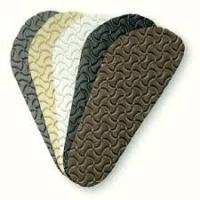
The GC agreed with the assessment of the EUIPO Board of Appeal that the trade mark in question was devoid of any distinctive character in respect of orthopaedic shoes and parts therefor.

The GC found that the repetitive sequence could extend infinitely in all four directions of the square and therefore be applied to any two- or three-dimensional surface.

Thus the sign at issue would be perceived immediately as representing a surface pattern.

It observed that the case-law relating to signs that are indissociable from the appearance of the products should be applicable in the case at issue.

Such case-law stated that as the average consumers do not usually presume the commercial origin of goods on the basis of the signs that are indissociable from the goods themselves, those signs will have distinctive character only if they depart signicantly from the sectorial standards or usual practices (judgments of 12 January 2006, Deutsche SiSi-Werke v OHIM, C‑173/04 P, EU:C:2006:20, paragraph 31, and 22 June 2006, Storck v OHIM, C‑25/05 P, EU:C:2006:422, paragraph 28).

In the judgment of 19 September 2012, Fraas v OHIM, “Tartan pattern in dark grey, light grey, black, beige, dark red and light red” (T‑50/11) the Court already applied such a test  in the case of a figurative mark consisting of a part of the shape of the product that it represents, inasmuch as the relevant public will immediately and without further thought perceive it as a representation of a particularly interesting or attractive detail of the product in question, rather than as an indication of its commercial origin.

According to such case law, the court concluded that it was well known that the surfaces of goods or their packaging are decorated with patterns for a variety of reasons, including enhancing their aesthetic appearance and/or for technical reasons.

The decision has been appealed before the ECJ (C-26/17 P).

This is not the first case addressing whether an outsole is capable of functioning as a trademark. Many will remenber that Louboutin, the renowned footwear brand based in Paris, registered as a trademark the bright-red lacquered sole featuring its luxury footwear and filed a trademark infringement lawsuit against Yves Saint Laurent, Zara and other competitors, in a number of countries, including Swiss, France, Germany, Belgium and the United States. In these cases, however, the limits of the protection granted to the colour red contained in a trademark were at issue, with very different outcomes.

Just for mention the most significant findings, the U.S. Second Circuit Court of Appeals (No. 11-3303, 2013) found that the Red Sole Trademark had acquired secondary meaning, but only to the extent the sole did contrast with the upper part of a shoe (i.e., not in case of monochromatic red shoes). On the contrary, The Swiss Federal Administrative Court ruled that the red soles are merely a decoration, ineligible for trademark protection (decision B-6219/2013) and the French Supreme Court (may 30, 2012) stated the 3D mark could not be registered because the shape lacks distinctiveness and is imposed by its function.

Jacopo Ciani

Patent or Utility Model: which distinction?

Four months ago, the Italian Supreme Court ruled again on the distinction between Patents and Utility Models (full Italian text here).

Vecam S.p.A. brought action before Milan IP Court asking for the declaration of invalidity of the Italian portion of European Patent No. 1024331, owned by Tecnosystemi S.p.A. The patent dealt with a “Flush-mount enclosure, particularly for making provisions for air-conditioning systems”. While resisting against Vecam, Tecnosystemy in alternative asked to establish whether the requirements for conversion of the Patent into a Utility Model were met.

Article 76.3 of the Italian Intellectual Property Code reads “A null patent may produce the effects of a different patent of which it possesses the requirements of validity and that would have been desired by the requesting party, if he had known of the nullity”.

On 13 May 2010, the IP Court upheld the claim of Vecam declaring the Italian portion of European patent no. 1024331 invalid. At the same time, the Court asserted that the legal requirements for conversion of the patent into a utility model were met.

Against the first instance decision, which downgraded the Patent into a Utility Model, Tecnosystemi filed an Appeal before Milan’s Court asking for the Italian European Patent no.1024331 to be recognized valid.

The Court of Appeal confirmed the decision of the first instance stating that the technological solution constituted an utility model. In particular, the Court explained that Tecnosystemi improved the usefulness of something already existing whilst it did not invent anything new.

More precisely, the air conditioning unit was built with a new device allowing a 180 degrees rotation of the flush-mount enclosure’s base aiming to facilitate the condensate’s drain.

Tecnosystemi then filed an appeal before the Italian Supreme Court assuming that the Court of Appeal, as the Judge of first instance had done, had not been able to identify how to correctly distinguish between Patent and Utility Model.

The Supreme Court declared the appeal inadmissible and, quoting two precedents (Italian Supreme Court – Judgments 8510/2008 – and 19688/2009), it clarified that Utility Models: require an inventive step capable of increasing the usefulness of something already existing rather than inventing a completely new product or process.

By this decision the Italian Supreme Court followed the so-called “Qualitative Doctrine”, whereby, while Patents relate to a new product or a new process Utility Models concern an existing object.

However, several scholars share the so-called “Quantitative Doctrine” whereby Patents require an higher inventive step.

Other proposals have emerged in Italy in the last few years, which aim at across-the board abolishing the category itself of utility models. This, on the basis of the intrinsic inconsistency of separating two different levels of ‘inventive character’ vis-à-vis the fact that, even for patents, nothing more than ‘non obviousness’ is required. Thus, once the ‘inventive step’ is a unitary requirement, there is no reason why to retain two different types /level of protection.

Giovanna Sverzellati

 Italian Supreme Court – Judgment No. 16949 of 10 August 2016

HOW MUCH A TRADEMARK SHALL BE USED BY A NON-PROFIT ASSOCIATION TO AVOID BEING DECLARED REVOKED FOR NON-USE? THE SEVERE OPINION OF THE COURT OF BOLOGNA

According to article 24 of the Italian Intellectual Property Code, an Italian trade mark shall be revoked (i) if, within a continuous period of five years, it has not been put to genuine use in connection with the goods or services in respect of which it is registered, and there are no proper reasons for non-use or (ii) if the use is suspended for the same amount of time.

Not many Italian decisions addressed the question of which uses are considered “genuine” and which is the sufficient amount of use that would put the right-owner safe from any contestation.

The Court of Bologna had the chance to investigate this question in a case (available here) involving a non-profit sailing club that sued a company when it discovered that it had started the production and commercialization of sailing cloths and accessories using the exact same trade mark already registered by the club and had registered a number of identical and similar trademarks for identical products (i.e. sailing accessories and garments).

immagine-iplens-moro

According to the defendants, however, the plaintiff could not enforce its earlier trademark because it had been used on the market in a manner that was not effective. Thus, they counter-claimed to declare it revoked for non-use.

The plaintiff resisted claiming that the use made of the “IL MORO” trademark in the years was genuine and continuous, in line with the purposes of the sailing club and the activities organized by its members. In particular, the plaintiff showed, by filing a number of pictures and invoices, that the trademark was used for clothes, shoes and accessories that were distributed for free during sailing races and similar events.

Bearing in mind that the rationale behind the provision on revocation for non-use is to “clean” the register from those trademark registration preventing third parties from registering and using a name or a logo as trademark in absence in the right owner of any interest in being secured such monopoly – which is indeed a goal consistent with the pro-competitive rationale of the requirement of availability (i.e. the need to keep free) – the case law actually adopts different approaches on the notion of use that is sufficient to evidence the subsistence of said interest.

According to a first theory, any type of use is sufficient, as long as it shows an actual interest of the right holder in continuing to distinguish its products/services on the market. Consequently, only the complete and total cessation, in any mode, of the trademark’s use would cause its revocation. Even a local, restrained in time or intermittent use could be thus considered sufficient (see Court of Milan decision of 10 October 1996, Court of Milan decision of 30 September 2002, Court of Turin decision of 21 December 2004 and Court of Rome decision of 22 May 2003 and, among the leading scholars, A. Vanzetti – V. Di Cataldo, Manuale di diritto industriale, Milan, 2012, page 283).

According to a second theory, to which the decision in comment adheres, only a sufficiently intense, stable and continuous use of the trademark on products or services offered for sale on the market can prevent revocation. This use shall be not symbolic: consumers shall be aware of the sign so that it is capable of distinguishing the products or services from the competitors’ (see Supreme Court case no. 16664 decision of 1 October 2012, Court of Naples decision of 2 February and Court of Milan 20 September 2002).

By upholding this second theory the Court of Bologna non only affirmed that the use made by the plaintiff was too limited for the small amount of sailing clothes and accessories produced by the club, but also claimed that said use was not genuine. This because the garments and accessories on which the trademark was fixed were promotional gadgets intended to be distributed for free to club members and in occasion of sailing events. In other words, they were not for sale. Thus, the “IL MORO” figurative trademark was, according to the Court of Bologna, not used to distinguish the sailing club’s products from the ones offered by other companies on the relevant market.

Even if the ‘requirement of availability’ would support the result of the decision, due to the limited use made of the trademark on the market, it is also true that trademark law does not require that only companies with a profitable business (and the consequent capability of demonstrating wide sales made on the Italian market) are entitled to register a trademark.

In particular, the provision requires the existence of a use and not that such use has generated incomes to the right owner. The EU Court of First Instance seems to have confirmed this point, having assessed – with respect to EU trademarks, but the provision is equivalent – that “the purpose of the provision is not to assess commercial success or to review the economic strategy of an undertaking, nor is it intended to restrict trade-mark protection to the case where large-scale commercial use has been made of the marks” (Case T-191/07 Anheuser‑Busch v OHIM, Inc. see also case T‑169/06, Charlott v OHIM and case T‑203/02 Sunrider v OHIM).

It thus seems that the evaluation of the existence of a use should be carried on taking into account also the type of business of the right-owner, on the basis of a case-to-case analysis. Otherwise, the trademarks registered by non-profit organizations would be seriously compromised.

Court of Bologna, case No. 9754/2013, 9 September 2015, Europa Yacht Club, Moro S.r.l. and Giovanni Benito Ballestrazzi v. Punta della Maestra S.r.l., Overseas Property LLC, ASD Il Moro di Venezia Yacht Club and Rama S.n.c..

Competition law’s application to patent settlement agreements: the first UK decision

When a pharmaceutical patent expires, the patent owner will normally face the competition of ‘generic‘ versions of the patented drug, which often means a dramatic fall in the originator product’s prices as well as an impending revenue cliff.

GlaxoSmithKline (hereinafter “GSK”) faced such a situation with regard to its patented anti-depressant product, Seroxat®, one of its best selling medications during the 2001-2004 time period. In 2001, a number of generics producers were taking steps to enter the market with their own versions of the product. GSK responded to the threat by commencing proceedings against two generics producers, Alpharma Limited (Alpharma) and Generics (UK) Limited (GUK), for breaching its patents.
Rather than taking the matter to trial, the parties proceeded to settle the case. The settlement terms included GSK paying certain sums to the generics producers and appointing them as its distributors of Seroxat®. In return, the generics producers agreed not to launch their own products into the UK market.

On the 12th of February 2016, the Competition and Markets Authority (former Office of Fair Trading) ran out an investigation against GSK and the generic companies finding that they had entered into anti-competitive reverse-payment settlements agreements for breaches of Chapter I of the Competition Act 1998 and Article 101 of the Treaty on the Functioning of the European Union (TFEU) (ex-Article 81 of the Treaty Establishing the European Community, TEC) (see the CMA press release at https://www.gov.uk/government/news/cma-fines-pharma-companies-45-millionfull, text of the decision yet to be published). The CMA found that the agreements effectively prevented the generic competitors from entering the paroxetine market and deprived the National Health Service of price falls averaging 70 per cent. Therefore it characterised the arrangements as a cartel and as an abuse of dominance by GSK.

The decision culminates in total fines of just under £50 million including a fine of £37.6 million against GSK. The size of the fine is itself significant: it is the second largest to have been imposed on an individual company by the UK competition authorities.

This is the first UK decision to consider the application of competition law to patent settlement agreements. However, the pharmaceuticals sector is not new to the attention of the competition authorities.

In the U.S., the FTC’s efforts to combat harmful reverse-payment settlement agreements resulted in the Supreme Court’s landmark decision in FTC v. Actavis, Inc., 133 S. Ct. 2223 (June 17, 2013), which held that these settlements are subject to antitrust scrutiny.

At the EU level, patent settlement were thoroughly reviewed in the Pharmaceutical Sector Inquiry, a report of the European Commission published on 8 July 2009 and followed by yearly Monitoring Reports (full texts here http://ec.europa.eu/competition/sectors/pharmaceuticals/inquiry/).

In 2013, the EU Commission fined Danish pharmaceutical company Lundbeck €93.8 million and its generic competitors €52.2 million following an investigation which found that Lundbeck had concluded deals with them to unlawfully prevent the market entry of competing generic versions of its branded citalopram, a blockbuster antidepressant, following the expiry of its patents (full text here http://ec.europa.eu/competition/antitrust/cases/dec_docs/39226/39226_8310_11.pdf).

Essentially, the Commission considered that Lundbeck had paid substantial sums to the generic competitors in return for a delay in launching generic products onto the market. Now Lundbeck is appealing against the Commission decision and a judgment is expected later this year.

In 2014, the European Commission fined the French pharmaceutical company Servier and five generics companies a total of 427.7 million (EUR). In that case, Servier implemented a strategy to exclude competitors and delay the entry of cheaper generic versions of its bestselling blood pressure medicine, perindopril. Since its patent protection came to an end generics companies started developing their own products, Servier challenged them and subsequently settled the cases, paying the generics companies to stay out of the market. Also Servier’s appeal against the Commission’s findings is currently before the European General Court.

Waiting for the outcomes of these rulings, the case at stake seems to fall squarely within the territory that the EU consistently considers as giving rise to an “object” or automatic infringement of EU and EU national competition law (cf. Guidelines on the application of article 101 TFEU (ex Article 81 TEC) to technology transfer agreements, 2014/C 89/03 of 28.3.2014). Indeed, the misuse of the patent settlements to restrict competition emerges clearly looking at the direction of the transfer of value. In genuine patent litigation settlement, any payment will tipically flow from the alleged infringer to the patentee. Here, on the contrary, it is the patentee which provides compensation to the infringer. This deal is a straight horizontal agreement in restraint of competition, which would be equally unlawful if it had been stipulated by two producers of generics. As Prof. Ghidini outlines in Profili evolutivi del diritto industriale, 2015, 426, the deal is unlawful not because it concerns a patent, but due to the payment for delaying the product’s entry in the market (cfr. Abbott A.F., Michel S.T., The right balance of competition policy and intellectual property: A perspective on settlement of pharmaceutical patent litigation, IDEA, 2006, 46).

It remains to be seen what further repercussions GSK may face from this case. It is possible that the Department of Health and any other customers of the product could consider to launch a claim for recovering loss they may have suffered because of the amount Seroxat® was overpriced as a result of GSK’s conduct.

Jacopo Ciani


UK Competition and Market Authority, 12 February 2016, CMA v. GlaxoSmithKline plc  and others, CE/9531-11

The Coca-Cola contour bottle without fluting cannot be a valid three-dimensional trademark according to the EU General Court

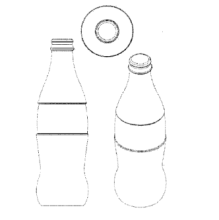
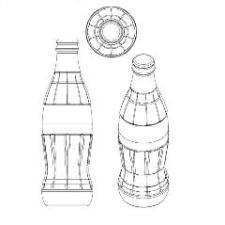
On 29 December 2011 The Coca-Cola Company filed an application at OHIM for registration of a Community trademark of the following three-dimensional sign consisting of the shape of a bottle (on the left), a variation of the popular Coca-Cola contour bottle with fluting (on the right):
bottle 1.pngbottle 2.jpg

On January 2013 the examiner dismissed the application having found that the mark applied for was devoid of distinctive character (under Article 7 (a)(b) of regulation No 207/2009) and had not acquired said character through use (under Article 7(3)). The applicant filed a notice of appeal with OHIM against the examiner’s decision, which was however dismissed by the OHIM Board of Appeal.

Against the decision of the Board of Appeal The Coca-Cola Company brought action before the EU General Court, which on 24 February 2016 (in case T-411/14, full text here) entirely dismissed the appeal and, as a consequence, confirmed the previous ruling of OHIM Board Appeal.

With two pleas Coca-Cola claimed: (a) that the mark it applied for has a distinctive character, being a natural evolution of the shape of the bottle “contour” with fluting which is popular and distinctive worldwide; and (b) that in any event mark it applied for has acquired distinctive character throughout the use in the market in combination with the contour bottle with fluting.

 Taking into account the first plea, the General Court recalled that the distinctive character must be assessed by reference to (i) the goods or services in respect of which registration has been applied for, and (ii) the perception of them by the relevant public.

More specifically, it emphasized, when those criteria are applied account must be taken of the perception of the average consumer  in relation to a three-dimensional mark consisting of the appearance of the goods themselves: in this respect average consumers are not in the habit of making assumptions about the origin of goods on the basis of their shape or the shape of their packaging in the absence of any word or graphic element, and it could therefore prove more difficult to establish distinctive character in relation to such a three-dimensional mark than in relation to a word or figurative mark.

Then, the Court examined the mark applied for, founding that either the lower, the middle and the top section of the bottle (i) do not enable the average consumer to infer the commercial origin of the goods concerned and (ii) do not display any particular features which stand out from what is available on the market.

Therefore, considering the mark applied for as a whole, the Court held that it is devoid of distinctive character for being a mere variant of the shape and packaging of the goods concerned, which will not enable the average consumer to distinguish the goods of Coca-Cola from those of other undertakings.

In considering the second plea, the Court underlined that for the mark to have acquired distinctiveness through use, Coca-Cola has the burden to demonstrate that at least a significant proportion of the relevant public throughout the European Union, by virtue of that mark, identifies the goods or services concerned as originating from Coca-Cola.

In evaluating that, the Court examined all the items of evidence already provided by Coca-Cola to the OHIM Board of Appeal, founding that none of them, considered both in isolation and as a whole, was sufficient to establish that the mark applied for has acquired distinctive through use.

In particular, the surveys submitted by the applicant covered only a part of the European Union (only 10 of 27 Member States) and the other secondary evidences such as investments, sales figures, advertising and articles did not, due to their imprecisions and inconsistencies, compensate for that deficiency: For example, the sales figures proved that Coca-Cola has sold large beverages throughout the EU, but the data provided referred to the ‘contour bottle’ without specifying whether that means the mark applied for or the contour bottle with fluting, consequently it does not enable a conclusion to be drawn regarding the relevant public’s perception of the three-dimensional sign applied for.

Furthermore, the Court pointed out that in general a three dimensional mark may acquire distinctive character through use, even if it is used in conjunction with a word mark or a figurative mark, when the relevant class of persons actually perceive the goods or services, designated exclusively by the mark applied for, as originating from a given undertaking (as stated in case C-353/03, Nestlè SA v. Mars UK Ltd). However, in the case in point the Court noted that the mark which Coca-Cola applied for was not clearly distinguishable from the mark it was alleged to be a part of, due to the fact that it was not obvious from the evidence provided by the applicant and particularly from the advertising material, whether the bottle that is shown in them is a representation of the contour bottle with fluting, or a representation of the mark applied for.

In view of the above, the General Court found that the mark Coca-Cola applied for has not even acquired distinctive character.

We can only agree with the whole outcome: to grant a trade mark in these circumstances would have given a perpetual monopoly to Coca-Cola in the shape of a bottle that is very commonplace on the market. The General Court set forth its arguments in a commendable way without being affected by the global popularity of Coca-Cola and its famous iconic bottle contour with fluting.

It remains to be seen whether, within two months of notification of the decision, Coca-Cola appeal the decision of the General Court to the Court of Justice of the European Union.

It may be not a coincidence and neither a déjà vu, but in the 1986 the House of Lord (Coca-Cola Co.’s Application [1986] 2 All ER 274) denied the Coca-Cola Company trademark protection for shape and design of the Coke bottle, assuming that it was “another attempt to expand on the boundaries of intellectual property and to convert a protective law into a source of monopoly”.

Matteo Aiosa

General Court of EU (Eight Chamber), The Coca-Cola Company v. Office for Harmonisation in the Internal Market, 24 February 2016, case T-411/14

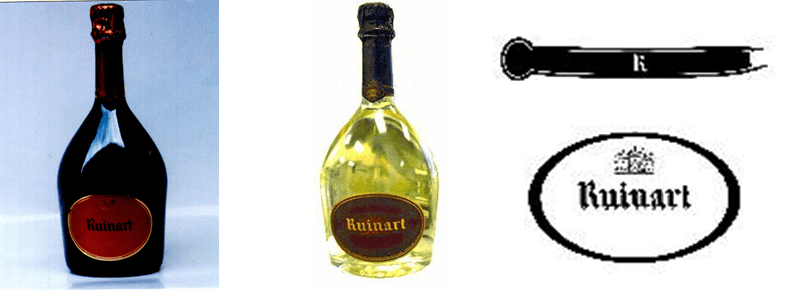
The Court of Turin ruled that shape of Ruinart champagne bottle has not distinctive character and rejected lookalike claims

The Court of Turin issued an interesting decision about the possibility to protect the shape of the bottle of the renowned Ruinart champagne (see the Italian text of the interim decision in the 2014 here, confirmed by the appeal in 2015, here). The action was brought by the French company MHCS, producer of Ruinart, against a south-Italian wine maker, Farnese Vini S.r.l. MHCS claimed that two bottles of Farnese spumante, Cuvée Cococciola and Gran Cuvée Rosè:

cuvee

recall all distinctive elements of Ruinart bottle (capsule, neckband, label, and particularly the shape), thus (i) infringing 3 community (3D and figurative) trademarks owned by MHCS:

New Picture (2)

and (ii) constituting an act of unfair competition (an confusing lookalike).

The Court first considered the single elements covered by MHCS trademarks (limited to: label, capsule, neckband, coat of arms on the main label and on the neckband, color, and Ruinart name). In relation to the capsule and the neckband, the Court found that, also in light of their necessary nature, the different features adopted by Farnese (colors, words, boards, etc.) sufficiently differentiate the two elements. In relation to the labels, the unique similarity is the oval/elliptic shape (although not perfectly overlapping). The Court considered the label’s form strictly connected to the shape of the bottle (for practical need of adhesion of the label to the bottle and for aesthetic reasons) which is oval as well, and therefore not protectable per se.

As to the shape of Ruinart bottle (not protected by MHCS community trademarks), the Court held it cannot be protected as a de facto trademark. Indeed, the Court considered the shape of the Ruinart bottle quite common and lacking of distinctive character (which occurs only when the shape is original and unusual within the market). Farnese demonstrated that its bottle is in fact a commonly available model named “Abram”, similar to the typical champagne bottle (in Italian, the so called Champagnotta prestige cuvée).

Finally, the Court excluded that Farnese bottles could be considered as a confusing look alike of the Ruinart’s ones. According to the Court of Turin’s case law, slavish imitation requires 3 conditions. Indeed, the shape of the product (or at least the combination of its single elements) must (i) be original (i.e. elaborated with respect of common shapes); (ii) not be technically necessitated; and (iii) show distinctive character (i.e. the ability to characterize the goods as originating from that particular company). Conversely, each element of Ruinart bottles claimed by MHCS (including the shape) is necessitated or common, nor their combination is distinctive.

On the contrary, the Court held that the real distinctive features of Ruinart bottles are (i) Ruinart name, (ii) the coat of arms, (iii) the label colors, and (iv) the chromatic combination between label and writings: all elements not reproduced by Farnese bottles. Moreover, the average consumer of Ruinart wines should be a careful one, thus further reducing any risk of confusion.

This decision follows the leading Italian case law on unfair competition, which is mainly focused on a “risk of confusion” analysis. However, it is worth noting that in recent years a different case law has followed a look-alike analysis beyond confusion (see Court of Milan 20 March 2014 and Court of Bari 20 October 2011). In this regard, the use of very similar elements of a packaging/aspect of a product, even without an actual risk of confusion, may be considered as an attempt to recall the most renowned product and the successful image/aura of the competitor’s brand, thus taking advantage of its commercial strategy. This analysis is based on a concept similar to the “link” required by the CJEU between the mark with a reputation and the similar sign (Adidas, C-408/01). However, even if said Milan and Bari Courts’ approach had been followed, the decisum would not have probably changed, since the similar elements and their combination were in fact considered as common and not distinctive.

Francesco Banterle

Court of Turin, 24 October 2014 and 17 April 2015, MHSC v. Farnese Vini S.r.l. et al.

Product-by-process patent = product patent??

Worthy of comment is a recent decision of EPO’s Enlarged Board of Appeal (March 25, 2015) in the cases Tomato II and Broccoli II (respectively, Case Number G2/12 here and Case Number G2/13 here). Both cases relate to the patentability of plants and plant matter under Article 53(b) EPC. The Tomato II case concerns a “method for breeding tomatoes having reduced water content and product of the method”, while the Broccoli II case concerns a “method for selective increase of the anticarcinogenic glucosinolates in brassica species”.

The EPO’s Enlarged Board of Appeal stated that even a product-by-process patent is a “product patent” autonomously protected from the process that describes the former and from which the implementation as product depends.

The EPO’s approach (see, in each decision: Reasons, Legal erosion of the exceptions to patentability,§ 6.(b), p.61) is open to criticism. On the one side it risks paralyzing the competitive dynamics of process innovation, in contrast an interpretation of articles 64(2) EPC and 34 TRIPs whereby third parties are allowed to make the same product with a totally different process—hence,   without any absolute block imposed by pre-existing product patents that are the fruit of a totally different intellectual process. On the other side, EPO’s opinion ‘forgets’ that in absence of that process, the product wouldn’t even exist, as the facts of the cases highlighted that no other processes were available to achieve the same result. The final outcome of said decisions is even more debatable as the process through which the product was described and claimed was essentially biological , thus as such non patentable: with the paradoxical ultimate result of allowing the patenting of a product that could be realized only through a process not patentable by definition!

Gustavo Ghidini

Gianluca De Cristofaro

EPO, Enlarged Board of Appeal, 25 March 2015, Case Number G2/12 and Case Number G 2/13, Tomato II and Broccoli II

updated on 12 November 2015

The scope of protection of a letter “B” as a mark cannot exclude from registration every other mark which contains that letter

By two twins-decision of 16 December 2014 (full text here) the OHIM Fourth Board of Appeal rejected oppositions against applications for registering two figurative marks consisting in a letter “B” inscribed in the shape of a bottle cap or placed in the centre of a wax seal, both for beers and alcoholic beverages. The grounds for the opposition were those laid down in art. 8(1)(b) CTMR: as the opponent was holder of a community figurative trade mark shaped by a letter “B” in the form of a rhombus, he claimed a likelihood of confusion between the signs. The Board argued that the distinctive character of a single letter on a rather simple geometrical shape is below and not enough to justify a likelihood of confusion. In principle, the public will not associate a single letter with an indication of origin. As a consequence, the scope of protection of a single letter as a mark cannot be such that it excludes from registration every other mark that contains that letter. The Board’s reasoning takes into account, at least implicitly, the public interest in keeping alphabetical letters free from private exclusive appropriation and gives a positive outcome in the direction of a public domain’s recognition and protection against misappropriation in trademark law.

Jacopo Ciani

Fourth Board of Appeal, 16 December 2014, R 1007/2014-4, Dibevit Import S.r.l. v. Berentzen-Gruppe Aktiengesellschaft