The General Court of the EU admits the registration of a trademark which evokes a shape

On September 13 and 15, 2011, the Perfetti Van Melle Spa filed two applications at Office for Harmonisation in the Internal Market (OHIM) for the registration of the word signs “Daisy” and “Margaritas” as community trademarks for confectionary products.

The OHIM and its Board of Appeal rejected both the applications on the basis that the signs didn’t have distinctive character compared to the products since (i) they were attributable to a name of a very common flower, and (ii) confectionary products in the form of a flower were already present on the market.

By a decision of December 16, 2015, in the joined cases T-381/13 and T-382/13 (full text here), the General Court of the EU affirmed the validity of the registration of “Daisy” and “Margaritas” trademarks and, as a consequence, annulled the decisions of the OHIM Board of Appeal.

The EU Court held that the signs “Daisy” and “Margaritas” do not meet the condition for refusal under article 7, (1), c), of the Community Trademark Regulation 2009/207/EC, because neither the term “Daisy” nor “Margaritas” have a sufficiently direct relationship between the mark and the goods. In fact, the meaning of such signs does not necessarily indicate confectionary products, while the fact that consumers may often intend such trademarks as a shape of confectionary products is not relevant.

In particular, the Court argued that both the mentioned words have some other meanings that consumers may keep in mind besides the form of a flower, for example the term “Daisy” refers to a female name or a cartoon character, whereas the term “Margaritas” refers to a female name or a popular cocktail.

Furthermore, the Court pointed out that the Board of Appeal failed to provide evidences of the fact that the shape of a daisy flower is widely used in the confectionery sector. Therefore, the circumstance that consumers have occasionally seen sweets in a form of flower and precisely in a daisy form is not sufficiently decisive to conclude that consumers, facing the terms “Daisy” and “Margaritas”, immediately recall such confectionary products.

In the light of the above, the Court held that the signs “Daisy” and “Margaritas”, used for confectionary products, have a minimum of distinctiveness. Thus, there was no reason for refusal of registration under article 7, (1), b), of the Community Trademark Regulation 2009/207/EC.

In sum, the Court recognized in principle, a ‘sufficient minimum’ of distinctiveness is recognised – allowing the registration – when there is no univocal identification between the verbal sign and a certain kind of a product. However, the doubt arises that if said minimum of distinctiveness concerns the shape of a product, the registration as a trademark involves an exclusiveness of potentially unlimited duration on the shape itself. Now, wouldn’t this risk preempting and bypassing the – more limited – protection by registration as a design (Directive 98/71), thus eventually produce an undue anti-competitive result?

General Court of EU (EGC), Perfetti Van Melle Spa v. Office for Harmonisation in the Internal Market, 16 December 2015, Cases T-381/13 and T-382/13.

Matteo Aiosa

The Court of Turin ruled that shape of Ruinart champagne bottle has not distinctive character and rejected lookalike claims

The Court of Turin issued an interesting decision about the possibility to protect the shape of the bottle of the renowned Ruinart champagne (see the Italian text of the interim decision in the 2014 here, confirmed by the appeal in 2015, here). The action was brought by the French company MHCS, producer of Ruinart, against a south-Italian wine maker, Farnese Vini S.r.l. MHCS claimed that two bottles of Farnese spumante, Cuvée Cococciola and Gran Cuvée Rosè:

cuvee

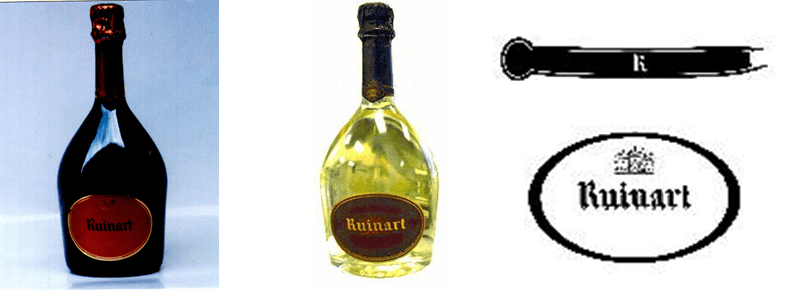
recall all distinctive elements of Ruinart bottle (capsule, neckband, label, and particularly the shape), thus (i) infringing 3 community (3D and figurative) trademarks owned by MHCS:

New Picture (2)

and (ii) constituting an act of unfair competition (an confusing lookalike).

The Court first considered the single elements covered by MHCS trademarks (limited to: label, capsule, neckband, coat of arms on the main label and on the neckband, color, and Ruinart name). In relation to the capsule and the neckband, the Court found that, also in light of their necessary nature, the different features adopted by Farnese (colors, words, boards, etc.) sufficiently differentiate the two elements. In relation to the labels, the unique similarity is the oval/elliptic shape (although not perfectly overlapping). The Court considered the label’s form strictly connected to the shape of the bottle (for practical need of adhesion of the label to the bottle and for aesthetic reasons) which is oval as well, and therefore not protectable per se.

As to the shape of Ruinart bottle (not protected by MHCS community trademarks), the Court held it cannot be protected as a de facto trademark. Indeed, the Court considered the shape of the Ruinart bottle quite common and lacking of distinctive character (which occurs only when the shape is original and unusual within the market). Farnese demonstrated that its bottle is in fact a commonly available model named “Abram”, similar to the typical champagne bottle (in Italian, the so called Champagnotta prestige cuvée).

Finally, the Court excluded that Farnese bottles could be considered as a confusing look alike of the Ruinart’s ones. According to the Court of Turin’s case law, slavish imitation requires 3 conditions. Indeed, the shape of the product (or at least the combination of its single elements) must (i) be original (i.e. elaborated with respect of common shapes); (ii) not be technically necessitated; and (iii) show distinctive character (i.e. the ability to characterize the goods as originating from that particular company). Conversely, each element of Ruinart bottles claimed by MHCS (including the shape) is necessitated or common, nor their combination is distinctive.

On the contrary, the Court held that the real distinctive features of Ruinart bottles are (i) Ruinart name, (ii) the coat of arms, (iii) the label colors, and (iv) the chromatic combination between label and writings: all elements not reproduced by Farnese bottles. Moreover, the average consumer of Ruinart wines should be a careful one, thus further reducing any risk of confusion.

This decision follows the leading Italian case law on unfair competition, which is mainly focused on a “risk of confusion” analysis. However, it is worth noting that in recent years a different case law has followed a look-alike analysis beyond confusion (see Court of Milan 20 March 2014 and Court of Bari 20 October 2011). In this regard, the use of very similar elements of a packaging/aspect of a product, even without an actual risk of confusion, may be considered as an attempt to recall the most renowned product and the successful image/aura of the competitor’s brand, thus taking advantage of its commercial strategy. This analysis is based on a concept similar to the “link” required by the CJEU between the mark with a reputation and the similar sign (Adidas, C-408/01). However, even if said Milan and Bari Courts’ approach had been followed, the decisum would not have probably changed, since the similar elements and their combination were in fact considered as common and not distinctive.

Francesco Banterle

Court of Turin, 24 October 2014 and 17 April 2015, MHSC v. Farnese Vini S.r.l. et al.

Right to be forgotten: the first Italian decision after Google Spain

By its judgment of 3 December 2015 (full text here), the Court of Rome issued the first decision of an Italian court dealing with the so called “right to be forgotten” after the ECJ leading case of 13 May 2014, C- 131/12, Google Spain SL, Google Inc. v Agencia Española de Protección de Datos, Costeja Mario González.

The applicant, a lawyer, sued Google, asking the de-listing of 14 links resulting from a list of results displayed following a search made on the basis of his name, on the assumption of the existence of a right to be forgotten. He argued that the links were referring to a court case dating back to the years 2012/2013 and dealing with an alleged fraud in which he was involved (but never condemned) with some representatives of the clergy and other subjects linked to the criminal organization known as “Banda della Magliana”. As a consequence, the lawyer called for the monetary compensation due to the illegal treatment of its personal data.

The Court of Rome dismissed the plaintiff’s request on the assumption that the disclosed personal data were both recent and of public interest.

The Court based its decision on the principles recently recognized by the Court of Justice in Google Spain (and already accepted by Italian previous case law, cfr. Cass. Civ. Sec. III, 05-04-2012, n. 5525).

In this case the ECJ ruled that the data subject may, in the light of his fundamental rights under Articles 7 and 8 of the EU Charter of Fundamental Rights (and in application of Article 12(b) and subparagraph (a) of the first paragraph of Article 14 of Directive 95/46/EC), request that the personal data in question no longer be made available to the general public by its inclusion in such a list of results. However, inasmuch as the removal of links from the list of results could, depending on the information at issue, have effects upon the legitimate interest of internet users potentially interested in having access to that information, “a fair balance should be sought in particular between that interest and the data subject’s fundamental rights under Articles 7 and 8 of the Charter” (par. 81).

Whilst “it should be held that those rights override, as a rule, not only the economic interest of the operator of the search engine but also the interest of the general public in finding that information upon a search relating to the data subject’s name”, the Court also recognised the existence of an exception to this general rule when “for particular reasons, such as the role played by the data subject in public life […], the interference with [the] fundamental rights [of the data subject] is justified by the preponderant interest of the general public in having, on account of [the] inclusion [of the information] in the list of results, access to the information in question” (par. 97).

The Article 29 Data Protection Working Party (hereinafter only “WP”) in its Guidelines on the implementation of the ECJ Judgement on Google Spain, adopted on 26 November 2014 for the purpose of establishing a list of common criteria to be used by European data protection authorities to evaluate whether data protection law has been complied with, stated that “no single criterion is, in itself, determinative”.

However among these criteria there are both whether the data are temporally relevant and not  excessive (i.e. closely related to the data’s age) and whether the data subject play a role in public life (s.c. public figures criterion).

With reference to the second criterion, even if it is not possible to establish with certainty the type of role in public life an individual must have to justify public access to information about them via a search result, the WP pointed out that “by way of illustration, politicians, senior public officials, business-people and members of the (regulated) professions can usually be considered to fulfil a role in public life”.

Under this test, the Court of Rome rejected the plaintiff’s request on the assumption that the treated personal data were both recent and of public interest and denied that the data subject had a right that the information relating to him should, at this point in time, no longer be linked to his name.

The decision can be welcomed to the extent it shows the benefits of the process of EU harmonization realized by means of the interpretative ruling of the ECJ and of the WP on the right to prevent indexing of personal data published on third parties’ web pages.

The judgement, in any case, works in the direction to limit the scope of application of the right to consign personal data to oblivion, since it affirms that the “public figure role” can be recognized not only to politicians and public officials but also to the large class of “business-people”, belonging to regulated professional orders.

Jacopo Ciani

Court of Rome, 3 December 2015, No. 23771, Dott.ssa Damiana Colla

The Court of Rome on the imitation of a mannequin head model

With its 5 August 2015 ruling (full text here, in Italian), the Court of Rome granted an interim injunction and a seizure order against an Austrian luxury legwear and bodywear company which – one year after terminating a long commercial relationship with an Italian mannequin manufacturer, relating to supply of a mannequin head model – began using a mannequin head model in some of its stores which was almost identical to the one designed by the Italian manufacturer but was neither supplied nor produced by said manufacturer.

The mannequin head model was not the subject-matter of a design registration. Having been on the market for decades, the model was not even protectable as a non-registered community design. As for its possible copyright protection, which the Italian mannequin manufacturer tried to claim, this was not granted by the Court of Rome (at least at the interim stage of the proceedings). Nevertheless, the Court of Rome found the use of the imitating mannequin heads made by the Austrian company to be an act of unfair competition, contrary to honest practices, under Article 2598 no. 3 of the Italian Civil Code (CC) – and enjoined the Austrian company from further displaying the mannequin heads in its stores. The use of the “imitating” mannequin heads, said the Court, would allow the Austrian company to exploit the commercial and creative efforts of the Italian manufacturer. Moreover, it added, this use would make the mannequin heads less appealing on the market, diluting their uniqueness.

Two aspects of the decision deserve a mention.

First of all, the imitation of products not covered by IP rights was traditionally repressed under Article 2598 no. 3 CC only where the imitation was of a systematic nature and concerned a plurality of products [the so called “parasitic unfair competition”, on which see the leading case Court of Cassation, 17 April 1962, no. 752, Motta v. Alemagna and more recently Court of Cassation, 29 October 2015, no. 22118]. The decision of the Court of Rome – concerning the imitation of a single product – goes further, in line with a recent trend in Italian case law, which has more and more frequently repressed as unfair competition under Article 2598 no. 3 CC the imitation of single products or economic initiatives (see for instance Court of Milan, 5 May 2012, in DeJure), notwithstanding the absence of provisions specifically prohibiting their imitation, on the grounds that the costs and investments borne by a competitor are, in themselves, worthy of protection and that exploiting these costs and investments without remunerating the competitor is therefore unlawful. Compatibility of this approach with the freedom of economic initiative under Article 41 of Italian Constitution is far from being certain.

Secondly, it was not clear – at the interim stage of the proceedings – whether the Austrian company directly manufactured the mannequin heads at stake or commissioned them from a third manufacturer. However, the Court of Rome found that this circumstance was not decisive with regard to the liability of the Austrian company for unfair competition, stating that, even if the mannequin heads had been simply commissioned by the Austrian company from a third party, the Austrian company would still be liable for its “significant and substantial” contribution to the unlawful conduct. On this point, the decision seems to be consistent with the well-established Italian case law concerning third party liability for acts of unfair competition, whereby all parties who play a role in the unlawful conduct are liable for unfair competition, included those who are not competitors, provided that the unfair competitor takes advantage of the conduct of the non-competitor.

Riccardo Perotti

Court of Rome, 5 August 2015, Almax v Wolford

The CJEU sheds light on the way to calculate the term of SPCs

Article 13 (1) of Regulation EC No. 469/2009 (concerning the supplementary protection certificate for medicinal products, “SPC”) provides that SPCs are calculated on the basis of “the date of first authorisation to place the product one the market in the Community”. Existing SPC regulation is however ambiguous on this point and EU member states have adopted divergent practices.

By decision of 2 October 2014 the Oberlandesgericht Wien has referred questions to CJEU on a preliminary ruling regarding the calculation of SPCs term under Article 13 (1) of Regulation EC No. 469/2009.

The referral concerned two queries: a) whether the date of an MA (Market Authorization) has to be determined according to Community law or that of the member state where the SPC application is filed; b) whether (under Community law) “the date of the first authorisation” – as per Article 13(1) of the Regulation – is the date the MA actually issued or the date the applicant is notified.

The CJEU issued its Decision on 6 October 2015 in the case C-471/14, Seattle Genetics Inc. v Österreichisches Patentamt (full text here).

Confirming both the conclusions and the arguments submitted by the Advocate General Niilo Jääskinen in his Opinion as of September 10, 2015, the Court clarified: a) that, since Article 13(1) of aforesaid Regulation contains no express reference to the laws of the member states, it is necessary to adopt an independent and uniform interpretation that will be valid throughout the EU; b) that the date of the first authorisation is a matter of Community law, not of the legislation of the member state where the marketing authorisation has effect. The Court declared that the EU legislator chose to use the Regulation as the legal instrument to create a standard SPCs system.

In evaluating the second question, the CJEU further pointed out that SPCs were created to ensure sufficient protection to encourage pharmaceutical research, in light of the fact the period of exclusivity granted by patents concerning pharmaceutical products is insufficient to cover the R&D investment necessary.

In this context, the right to market a new drug arises on the date the patent holder becomes aware that the MA has been issued.

The Court therefore answered the second question by confirming that it is the date of notification of the MA that is to be considered the “date of the first authorisation”, this is the date to be taken into account in calculating the term of SPC.

As a result of this ruling, SPCs holders will benefit from a longer term of protection – by up to some weeks. Furthermore, a number of SPCs will likely need to have their duration recalculated.

 Matteo Aiosa

Court of Justice, Eighth Chamber, 6 October 2015, C-471/14, Seattle Genetics Inc. v Österreichisches Patentamt.

Huawei v. ZTE: Enforcing standard-essential patents as abuse of dominance

Following the request for a preliminary ruling issued by the Landgericht of Düsseldorf (Germany), on July 16th 2015, the European Court of Justice addressed the question whether or not, and at what conditions, the firm holding a standard-essential patent (SEP: namely, a patent essential to produce manufactures in compliance with a particular standard), which has committed to grant a license to third parties on FRAND terms, abuses its dominant position by seeking injunctions against alleged infringers (decision available here).

The long-awaited judgment of the Court confirms the general approach adopted by the Commission in both Motorola and Samsung cases (available here and here). However, while the Commission had merely stated that enforcing a SEP in court can constitute an abuse of dominance under certain circumstances, the ECJ decision goes further, clarifying what those circumstances are. In particular, the Court held that seeking an injunction against an alleged infringer does not violate competition law when the following conditions are met:

  1. prior to bringing the action, the SEP holder has informed the alleged infringer of the violation of its intellectual property right, specifying the mode of infringement;
  2. the SEP holder has presented a written offer for a license on FRAND terms to the “infringer” (which has previously expressed its intention to conclude a license agreement). The offer must include all the relevant conditions of the agreement, in particular the royalty rate applied and the way it is calculated;
  3. the potential licensee has not “diligently responded to [patent owner’s] offer in accordance with recognized commercial practices in the field and in good faith”, and has continued to use the protected technology.

The decision of the Court of Justice seems to subordinate the finding of abuse to the “bad faith” of both SEP owners and producers of standard-based products. On the one hand, the formers have to concretely fulfill the obligation to the standardization bodies consisting in giving a license on FRAND conditions to third parties. Indeed, a patent cannot obtain the SEP status unless the legitimate holder undertakes to grant a FRAND license to anyone who may require it, in order to prevent the SEP holder from “reserv[ing] to itself the manufacture of the products in question”. Thus, it is not surprising that, according to the ECJ, the patent owner may incur in an abuse of dominance if it seeks an infringement injunction without even submitting a licensing agreement to the alleged infringer.

On the other hand, the ECJ imposes the obligation of good faith also to the potential licensee, which – having decided not to accept the offer submitted by the patent owner – “may rely on the abusive nature of an action for a prohibitory injunction or for the recall of products only if it has submitted to the proprietor of the SEP in question, promptly and in writing, a specific counter-offer that corresponds to FRAND terms”.

The ECJ judgment has definitely the merit of striking a reasonable balance between the interests at stake: those of the potential (and willing) licensees, which supposedly made specific investments relying on the FRAND license promised by the SEP holder; and those of the SEP holder itself, which should be granted the right to effectively protect its intellectual property rights from free-riders.

Nonetheless, the intervention of European judges leaves some issues unsolved. Firstly, the decision does not explain when a license can be considered FRAND. Secondly, it does not answer the question whether holding a SEP implies, per se, a dominant position on the market (actually, the referring court had not asked about the finding of dominance). At first glance, there seems to be the glimmer of an opening for such a conclusion. A passage of the sentence, in fact, reads as follows: “[…] the patent at issue is essential to a standard established by a standardization body, rendering its use indispensable to all competitors which envisage manufacturing products that comply with the standard to which it is linked. That features distinguishes SEPs from patents that are non essential to a standard and which normally allow third parties to manufacture competing products without recourse to the patent concerned and without compromising the essential functions of the product in question” (emphasis added). This appears quite close to an irrebuttable presumption of dominance. A debatable position: in my view, the presumption should be rebuttable (as suggested by the Advocate General Whatalet in his opinion, available here), hence the judges should continue assessing, case-by-case, a situation of actual, effective dominance.

Piera Francesca Piserà

CJEU, 16 July 2015, case C-170/2013, Huawei Technologies Co. Ltd. v. ZTE Deutschland GmbH.

Trade Secrets: EU Commission’s Proposal for a Directive

In November 2013, the European Commission (EC) proposed a draft Directive on “the protection of undisclosed know-how and business information (trade secrets) against unlawful acquisition, use and disclosure” (full text here). The draft was approved in May 2014 by the Council of the European Union (full text here).

The proposal is innovative, it has no precedent in EU legislation. It has the ambitious goal of aligning existing laws against the unlawful acquisition, use and disclosure of trade secrets across the EU. This impulse of harmonization is consistent and part of the broader strategy of the EC aiming at strengthening the single market for IP rights.

At the moment, the proposal is still under scrutiny following the ordinary EU legislative procedure. Therefore, the final directive is not due to be issued before the end of 2015.

The draft directive is the final step of a thorough assessment of the role played by trade secrets in enhancing innovation and competition within the EU market, in particular through their interaction with intellectual property, and of the legal framework governing them. The analysis was carried out on the basis of two external studies and consultations with stakeholders.

One of the main results of this assessment was that the legal framework governing trade secrets protection is highly fragmented throughout the EU. Hence, corporations have less incentives to do cross border investments in R&D or to exchange valuable information within the EU. Thus, the proposal starts by giving a uniform definition of trade secrets in accordance with existing international binding standards such as art. 39.2 of the TRIPS Agreement. Essentially, information is considered a trade secret when it is not easily accessible by an average expert in the field, it has a commercial value and it has been subjected to reasonable secrecy measures. Furthermore, the draft defines the relevant forms of unlawful acquisition, use and disclosure of trade secrets and clarifies that reverse engineering and parallel innovation shall be considered a lawful manner of appropriation of trade secrets.

Moreover, the proposal harmonizes the legal remedies available to plaintiffs to enforce the misappropriation of trade secrets: in particular, injunctions and corrective measures (i.e. the cessation of or prohibition on the use or disclosure of trade secrets, the prohibition on the production or import/export of “infringing goods” and the adoption of appropriate corrective measures with regard to the infringing goods), interim and precautionary measures at the request of trade secret holder, and the victim’s right to compensation for the damages caused by the unlawful use or disclosure of the misappropriated trade secret.

In conclusion, an analysis of this general framework indicates that trade secrets are not yet being elevated, in terms of status and legal protection, to the level of IP rights. In this manner, the proposal avoids the risk that patents, and their related pro-competitive effects such as disclosure of information, are replaced by trade secrets.

Alessandro Massolo

Researcher at Osservatorio di proprietà intellettuale, concorrenza e comunicazioni, LUISS Guido Carli

Topographic maps as databases: CJEU

The CJEU ruled that topographic maps may fall within database protection under Directive 96/9 (full text here). The dispute concerned the use by Verlag Esterbauer, an Austrian travel books publisher, of certain topographic maps published by the Land of Bavaria. In particular, Verlag Esterbauer scanned the maps and extracted the underlying geographic data with a graphics programme to produce and market its own maps dedicated to walkers and cyclists.

According to the Court, the concept of “database” must be interpreted widely, as collections of works and/or other data, in any form, without technical or material restrictions, therefore applying also to analog databases. Indeed, the Court stressed the “functional” nature of database protection and its aim at fostering investment in data processing systems.

The main requirement of a database under Art. 1(2) of Directive 96/9 is the existence of “independent materials”, i.e. separable without affecting their value. Independent materials can also consist of combination of pieces of information, if they have autonomous informative value after being extracted. This may be the case of geographical information (e.g., “geographical coordinates point” plus “the numbered code used by the map producer to designate a unique feature, such as a church”), as long as the extraction of such data from the map does not affect their autonomous value. Under the broad definition of database, this autonomous value shall be assessed vis-à-vis the degree of interest of third parties to the extracted material, irrespective of the fact that such value might diminish after the extraction.

The Court found that in the captioned case: (i) Verlag Esterbauer made an autonomous commercial use of the information extracted from the Land of Bavaria’s maps, and (ii) it provided its customers relevant geographical information. Thus, such geographical information constitutes “independent material” from a database.

It seems all too evident that the Court, in line with its settled case-law (see our comments on the Ryanair case here), keeps broadening the notion of database under Directive 96/9 with the aim of further protecting investments in the information market.

Francesco Banterle

CJEU, 29 October 2015, Case C-490/14, Freistaat Bayern v Verlag Esterbauer GmbH

Product-by-process patent = product patent??

Worthy of comment is a recent decision of EPO’s Enlarged Board of Appeal (March 25, 2015) in the cases Tomato II and Broccoli II (respectively, Case Number G2/12 here and Case Number G2/13 here). Both cases relate to the patentability of plants and plant matter under Article 53(b) EPC. The Tomato II case concerns a “method for breeding tomatoes having reduced water content and product of the method”, while the Broccoli II case concerns a “method for selective increase of the anticarcinogenic glucosinolates in brassica species”.

The EPO’s Enlarged Board of Appeal stated that even a product-by-process patent is a “product patent” autonomously protected from the process that describes the former and from which the implementation as product depends.

The EPO’s approach (see, in each decision: Reasons, Legal erosion of the exceptions to patentability,§ 6.(b), p.61) is open to criticism. On the one side it risks paralyzing the competitive dynamics of process innovation, in contrast an interpretation of articles 64(2) EPC and 34 TRIPs whereby third parties are allowed to make the same product with a totally different process—hence,   without any absolute block imposed by pre-existing product patents that are the fruit of a totally different intellectual process. On the other side, EPO’s opinion ‘forgets’ that in absence of that process, the product wouldn’t even exist, as the facts of the cases highlighted that no other processes were available to achieve the same result. The final outcome of said decisions is even more debatable as the process through which the product was described and claimed was essentially biological , thus as such non patentable: with the paradoxical ultimate result of allowing the patenting of a product that could be realized only through a process not patentable by definition!

Gustavo Ghidini

Gianluca De Cristofaro

EPO, Enlarged Board of Appeal, 25 March 2015, Case Number G2/12 and Case Number G 2/13, Tomato II and Broccoli II

updated on 12 November 2015

US 2nd Circuit holds that Google Books does not infringe copyright

Nearly two years after the US District Court for the Southern District of New York decision on the Google Books Library Project, the US Court of Appeals for the 2nd Circuit confirmed that the scanning activities of Google within its Library Project are to be considered a fair google-books-featured1-500x236use of copyright works under §107 of the US Copyright Act (full text here). The Litigation was brought against Google by the Association of American Publishers (AAP) and the Authors’ Guild, on behalf of authors whose books Google had digitized without permission, claiming that Google’s digital copying ofentire books, allowing users through the snippet function to read portions, would infringe author’s copyrights, providing consumers with a substitute for the original works.

In 2012, the AAP and Google concluded a settlement agreement, but this did not arrest the ongoing litigation between the Authors’ Guild and Google.

Judge Pierre N. Leval held among other things that Google’s making of a digital copy to provide a search function is a “highly transformative use”, with the meaning set forth in Campbell v. Acuff-Rose Music, Inc. (510 U.S. 569, U.S. 1994) to “add something new, with a further purpose or different character, altering the first with new expression, meaning, or message”.

In particular, the court said that Google’s book search function was transformative because it “augments public knowledge by making available information about the plaintiffs’ books without providing the public with a substantial substitute for matter protected by the plaintiffs’ copyright interests in the original works or derivatives of them”. Even if the snippet reveals some copyright–protected authorial expressions, the brevity and the cumbersome, disjointed and incomplete nature of the snippets just helps users to evaluate whether books falls within the scope of their interest, but does not allow to make them a competing substitute for the original.
A unanimous three-judge panel rejected the Author’s Guild’s argument that Google’s distribution of the digital copies to libraries exposed the books to risks of loss. On the contrary, the court said that Google Books did not have a strong effect on the potential market for the books and that any losses would eventually address interests unrelated to copyright.
If the decision will be upheld by the Supreme Court, it will predictably become a landmark ruling in copyright law. Its long term effects could be relevant. In addition to the public benefits of Google Books, which expands access to books and allows scholars to analyse huge amount of data, the decision might open the door for creating similar types of digitization projects involving copyrighted works. In this regard, it will be interesting to carefully follow if and how the decision will travel outside the United States, especially in those legal systems which does not have a fair use clause.

Predictably, in any case, the decision will not meet with unanimous praise. The decision proposes an extensive application of the transformative use doctrine, which could be interpreted as a lack of consistency concerning how the degree of transformativeness is to be assessed. This point could be matter for further guidance by the Supreme Court.

In the meantime, while Google heaved a sigh of relief, the next candidate is already on the horizon. It is the online trading platform Amazon, subject to both antitrust investigations and further calls for regulation. But this is another story…

Jacopo Ciani